

MMIW NC and UNCW Host 8th Annual Missing and Murdered Indigenous Women Event
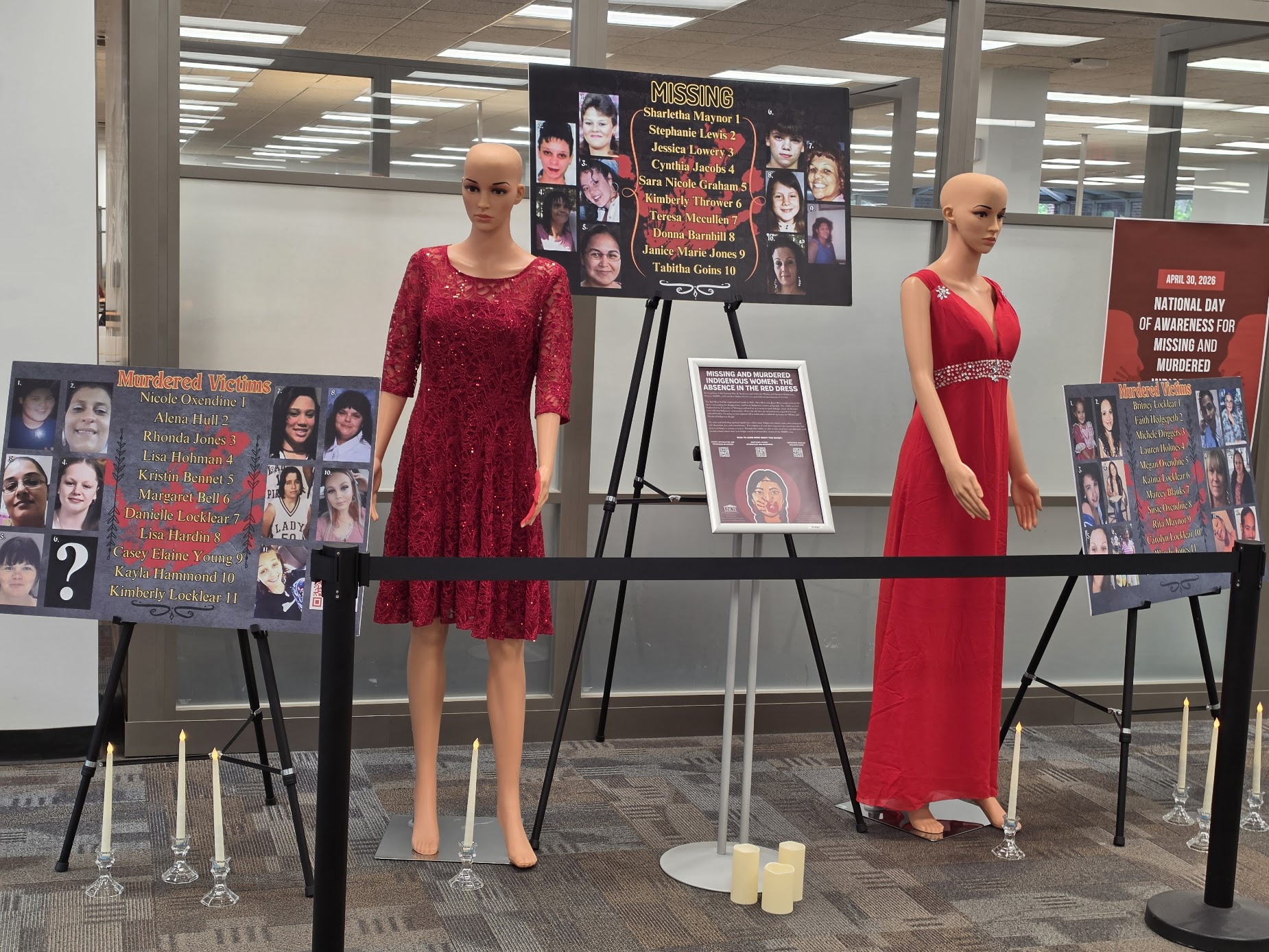
Menaka Raguparan curated this exhibit, professor in the Sociology and Criminal Justice department at University of North Carolina Wilmington.
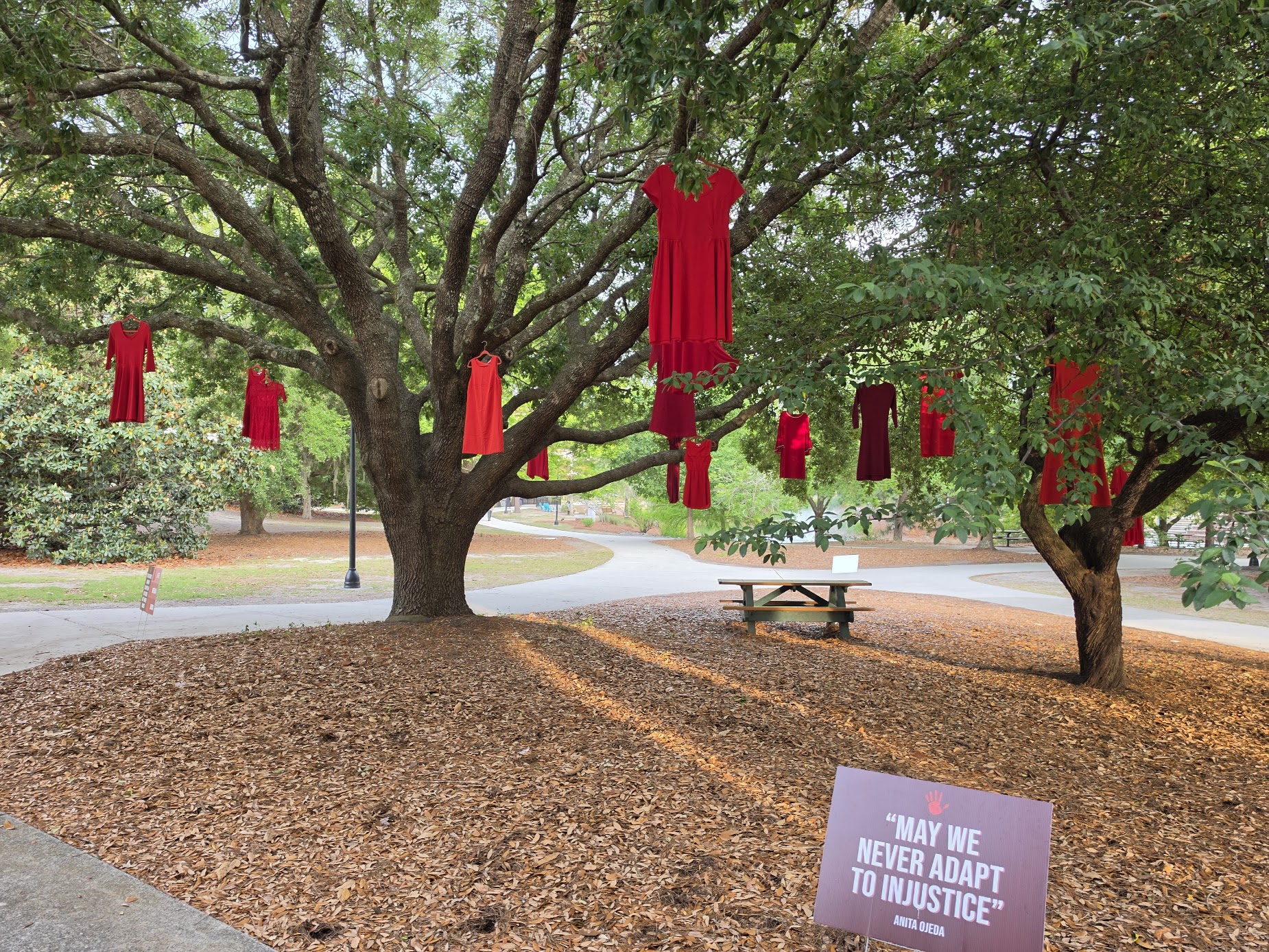
REDress Project along UNC-Wilmington's campus.
Event highlights crisis facing Indigenous women while advancing awareness, healing, and systemic accountability across North Carolina.
Throughout the month of April, UNCW hosted a public exhibit at Randall Library highlighting the ongoing crisis, designed by Menaka Raguparan, Assistant Professor in the Sociology and Criminal Justice department at the University of North Carolina Wilmington. Featured in the exhibit was The REDress Project, an internationally recognized installation created by Jaime Black. The installation uses empty red dresses to symbolize the thousands of Indigenous women who are missing or murdered across North America. UNCW remains one of the only campuses in North Carolina to host a sustained Red Dress exhibit, with installations displayed across campus throughout April and May—serving as a powerful visual reminder that these lives are not forgotten. This year, inside the library, dresses were displayed on mannequins to further draw attention to the exhibit, accompanied by the names of Indigenous women in North Carolina who are missing or murdered, grounding the installation in the realities of the local community.
The April 30 event was held in the Warwick Ballroom and intentionally scheduled ahead of the National Day of Awareness and Action for Missing and Murdered Indigenous Women and Girls on May 5, a nationally recognized day to honor victims and call for systemic change. The program featured a series of meaningful, community-centered sessions, including a film screening and discussion, spoken-word poetry and drumming, a healing circle, and a candlelight vigil to honor victims, survivors, and families.
“Across this country, Indigenous women, girls, and Two-Spirit relatives are going missing and being murdered at alarming rates,” said Dr. Crystal Cavalier-Keck, founder of MMIW NC. “For far too long, our people have been invisible in the data and overlooked in the response. MMIW NC exists to change that.” “Our coalition has already documented at least 1,000 Indigenous women, girls, and Two-Spirit individuals who have been missing or murdered across North Carolina,” she added. “And that number continues to grow. We are identifying new cases every week—because for generations, many of our relatives were never counted, never recorded, and never given the attention they deserved.”
The MMIW NC Coalition works to examine gaps in government and law enforcement responses, barriers to services, and systemic failures that contribute to violence against Indigenous communities. One of its key initiatives is the development of a statewide database and reporting system—an effort to ensure that families can document their loved ones, that cases are not lost or ignored, and that Indigenous people are no longer erased from official records. Menaka Raguparan none of the event organizers, emphasized the structural and institutional challenges that perpetuate this crisis. "These include inadequate data systems that fail to properly identify Indigenous victims, jurisdictional conflicts between tribal, state, and federal authorities, and limitations on tribal sovereignty that restrict the ability to prosecute violent crimes." “These gaps mean Indigenous women are often not counted, not protected, and not given justice,” Raguparan said.
Dr. Cavalier-Keck emphasized that the work of MMIW NC extends beyond awareness and into deeper systemic and community healing. “This is not just an issue. This is our mothers, our daughters, our sisters, our relatives,” she said. “This work is about truth-telling, accountability, and bringing our people home.” Her current research also highlights the urgent need to address lateral violence within American Indian and Indigenous communities—an often-silenced and complex issue rooted in internalized oppression. Research across Indigenous communities in the United States, Canada, and Australia indicates that lateral violence remains prevalent, with many individuals reporting both knowing survivorship and participation in these dynamics. Addressing this issue requires intentional dialogue, culturally grounded healing practices, and community-led solutions to break cycles of harm and restore balance. "Events like this are critical for raising awareness and pushing communities, governments and institutions toward accountability.”
MMIW NC’s work focuses not only on response, but also on prevention and empowerment. The organization provides education to Indigenous women and girls about violence, offers self-defense training, and builds community awareness to ensure individuals and families are better equipped to protect themselves. Through grassroots organizing, public awareness campaigns, and community-based events, MMIW NC continues to create spaces for solidarity, visibility, and healing. Since 2022, UNCW’s awareness initiatives have included public art installations, panel discussions, student-led research projects, solidarity walks, and candlelight vigils. These efforts contribute to a growing body of knowledge and engagement around the MMIW crisis, while also empowering students and community members to take part in advocacy and change.
Looking ahead, UNCW and MMIW NC plan to host next year’s conference again in Wilmington during the final week of April, continuing their commitment to education, advocacy, and community healing. The continued presence of the Red Dress installations on campus reflects a long-term investment in keeping this issue visible and centering Indigenous voices in the conversation. “This is about making sure our people are never invisible again,” Dr. Cavalier-Keck said. “We are still here—and we are fighting to bring our people home.” Families and survivors are encouraged to report cases and share information through MMIW NC’s reporting system at: https://mmiwnc.com/file-a-report. MMIW NC extends its gratitude to community partners and supporters, including Sheena Richardson of Trillium Health NC and 7 Directions of Service, whose collaboration helps make this work possible.
Tia Hunt
7 Directions of Service
+1 910-722-9459
email us here
Visit us on social media:
Instagram
Facebook
X
Legal Disclaimer:
EIN Presswire provides this news content "as is" without warranty of any kind. We do not accept any responsibility or liability for the accuracy, content, images, videos, licenses, completeness, legality, or reliability of the information contained in this article. If you have any complaints or copyright issues related to this article, kindly contact the author above.
